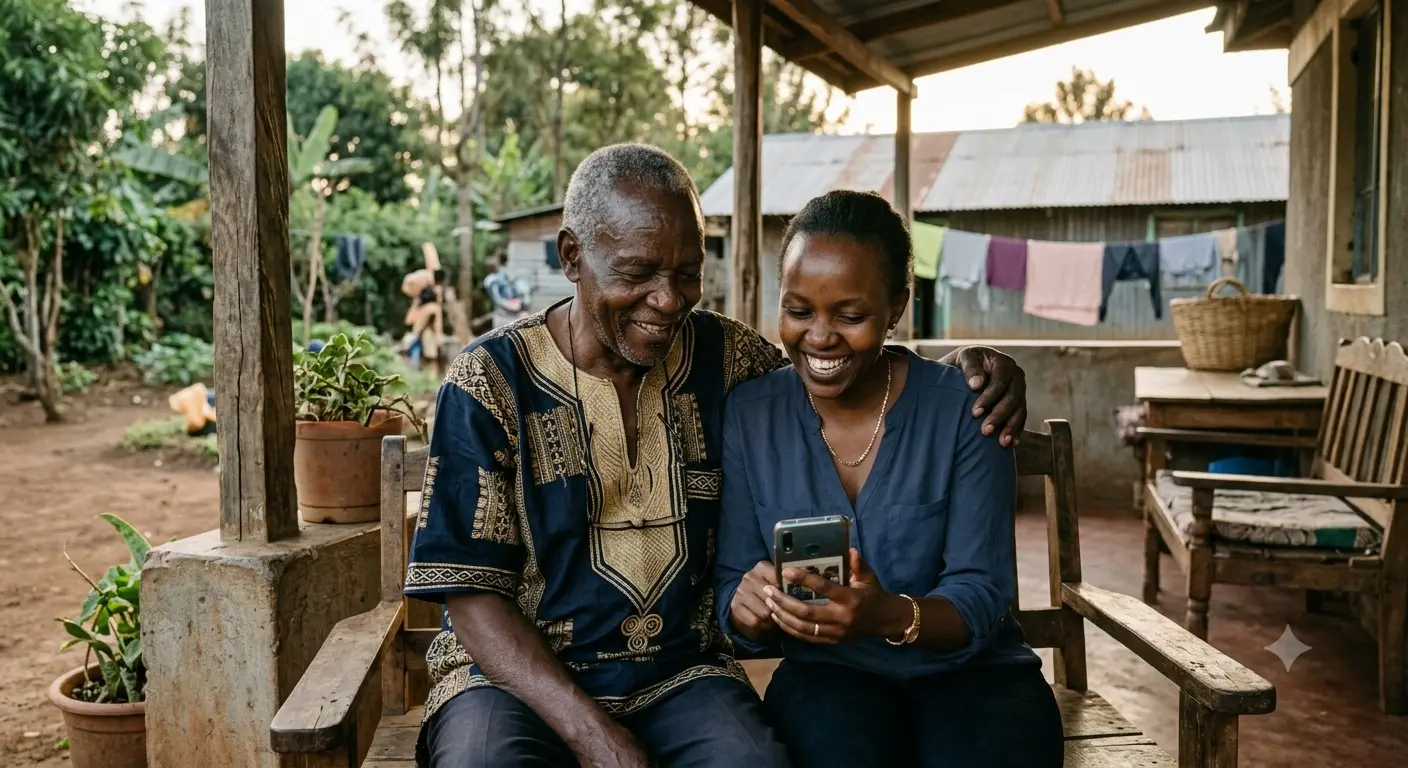
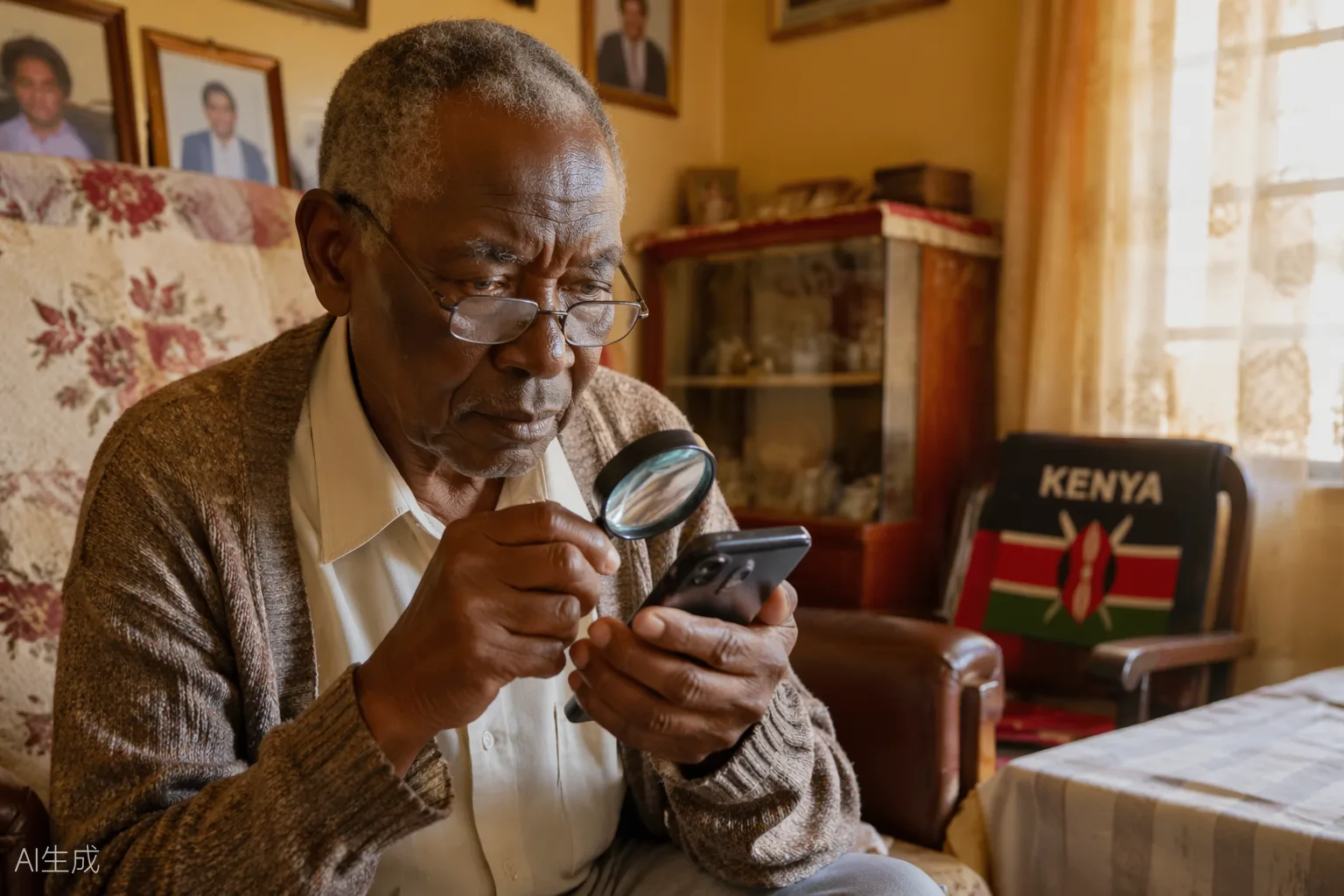
Older African adult using a smartphone with magnification support
Symbolic image: AI-generated for illustrative purposes. Not attributed to any real individual or institution.
Research Report · June 2026
2.8/10 Overall Readiness Score — Critical Gaps

Kenya Senior
Digital Health
Readiness Index

Kenya has built Africa's most celebrated mobile economy — but for Kenyans aged 60 and above, the digital health revolution has not arrived. This index documents the gap.

Author Kevin Jonathan Otieno
Platform Senior Citizens Tech Haven
Location Nakuru, Kenya
2.8 out of 10 — overall readiness score
45% of Kenyan seniors have no formal education
<5 in 10 Kenyans over 70 own a phone
0 formal geriatric training pathways in Kenya
14% of older persons hold health insurance

Kenya's Digital Health Revolution Has Left Older Adults Behind.

Kenya has earned global recognition as the "Silicon Savannah." Mobile money, expanding internet infrastructure, and digital government services have placed it at the forefront of Africa's digital transformation. But digital progress has not been distributed equally.

This report evaluates Kenya's readiness to support older adults — those aged 60 and above — through digital health technologies, telemedicine services, artificial intelligence applications, and age-friendly healthcare systems. The findings reveal a structural implementation gap between national ambitions and community realities.

While policy frameworks exist, including the Digital Health Act (2023), the National eHealth Policy (2016–2030), and the Healthy Ageing and Older Persons' Health Strategy (2021–2026), the benefits on the ground remain critically limited.

"Managed Dependency"

The condition of being statistically included in digital systems while remaining practically dependent on younger relatives for navigation. Kenya reports strong mobile penetration figures — but many older adults who are "counted" cannot independently send money, check a balance, book a health appointment, or use eCitizen services. They are counted. They are not empowered.

Why This Report Matters

Digital health readiness is not a technical metric — it is a public health issue, a social protection issue, and a national development issue. As Kenya's population of older adults grows, exclusion from digital health tools will compound inequality in access to healthcare services and outcomes.
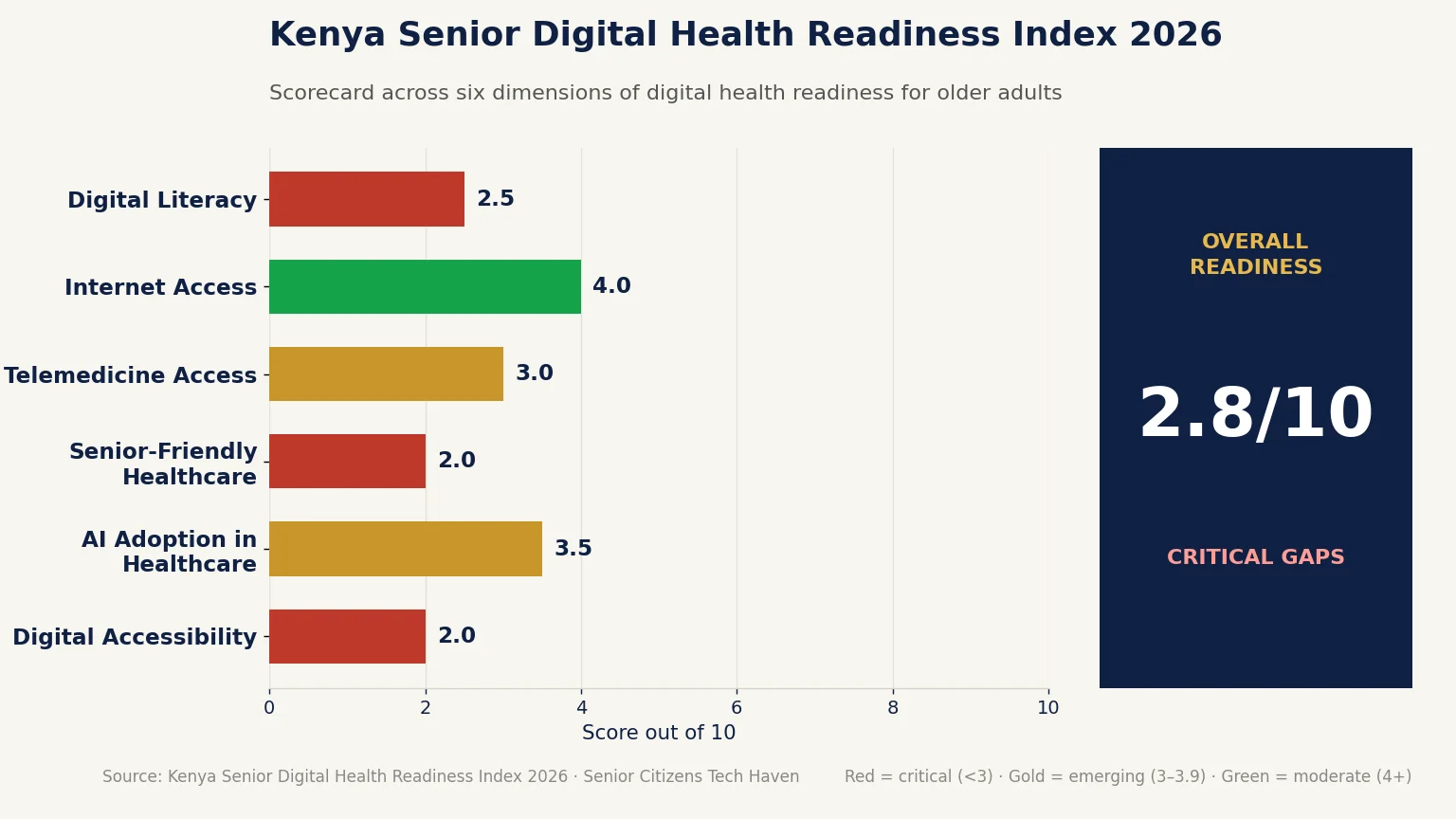
Six Dimensions. Six Critical Gaps.

The Kenya Senior Digital Health Readiness Index evaluates six dimensions critical to digital health participation among older adults. Scores are qualitative advocacy indicators benchmarked against policy availability, implementation maturity, and measurable outcomes.

Kenya Senior Digital Health Readiness Index 2026 Scorecard showing scores across six dimensions: Digital Literacy 2.5, Internet Access 4.0, Telemedicine Access 3.0, Senior-Friendly Healthcare 2.0, AI Adoption in Healthcare 3.5, Digital Accessibility 2.0. Overall readiness score: 2.8/10 — Critical Gaps.

Source: SCTH Research 2026. Scores compiled from Kenya Ministry of Health Strategy (2024), Statista, Nation Media, and digital health reports. Scoring is qualitative based on available data and policy analysis.

Timeline-style healthcare research graphic illustrating changes in older adult care
The Global Gap
"While the Global North builds AI-powered predictive care, Kenyan seniors wait in queues at underfunded dispensaries."
Symbolic image: AI-generated for illustrative purposes. Not attributed to any real institution or individual.

The Six Dimensions of Readiness

01
Digital Literacy
2.5 / 10
Kenya's Ajira Digital programme has trained 50,000 freelancers but targets youth, women, refugees, and ASAL communities. There is no mention of older adults in its curriculum. The Ministry of Health's Healthy Ageing Strategy (2021–2026) acknowledges that "data on ageing and health is limited." Globally, elderly digital literacy is approximately 40% lower than youth levels (OECD, 2023).
The Hard TruthKenya has no national, senior-focused digital literacy programme. Older adults remain largely invisible in the national digital transformation agenda.
02
Internet Access
4.0 / 10
National mobile phone ownership stands at 53.7% (CA/KNBS 2023/24), but disaggregated by age the picture shifts dramatically. UN Women Kenya data shows mobile ownership peaks at 85% for ages 35–39 but falls to just 45% for Kenyans aged 70+. Within that bracket, women face even deeper exclusion. Additionally, 11.3% of Kenyans use phones without owning them — highlighting shared-device inequality.
The Hard TruthFor every 10 Kenyans over 70, fewer than 5 own a phone. The devices powering modern digital health are simply not in older adults' hands.
03
Telemedicine Access
3.0 / 10
Kenya's Digital Health Act (2023) established the Digital Health Agency and deployed the Electronic Community Health Information System (eCHIS) — equipping 107,000 Community Health Promoters with devices by mid-2024. However, an investigative report by Nation Media (December 2025) and reports from Living Goods exposed deep operational failures: devices that freeze and crash, data costs paid out of pocket, and nationwide system outages that forced a fallback to paper tools for nearly two consecutive months in early 2025.
The Hard TruthKenya has policies and distributed devices. But the infrastructure, technical support, and connectivity to make telemedicine operational for rural older adults do not exist at scale.
04
Senior-Friendly Healthcare
2.0 / 10
Kenya has zero formal training pathways for geriatric medicine or gerontology in medical colleges. No specialised care units for older persons exist within public health facilities. Only 14% of older persons hold health insurance, and most insurance frameworks strictly exclude chronic non-communicable diseases — which account for over 50% of Kenyan hospital admissions. The Inua Jamii safety net pays KES 2,000 per month, unadjusted for inflation in over a decade.
The Hard TruthWhile the constitution guarantees elder care, Kenya lacks geriatric training, specialised hospital units, chronic disease coverage, and social protection sufficient to fund healthcare.
05
AI Adoption in Healthcare
3.5 / 10
Kenya hosts a genuinely innovative AI cluster including IBM Research Africa (epidemiological tracking), Wazi AI (mental health chatbots), Medic Mobile (patient monitoring), and LifeBank Kenya (blood supply chain optimisation). The AI in Health Kenya Convergence 2026 formalised a Community of Practice. However, a critical gap remains: zero senior-specific AI health applications. The tech ecosystem does not view older adults as a viable user group.
The Hard TruthKenya has exceptional local AI talent. But older adults are entirely excluded from predictive care, fall detection, or vocal health tools designed for their needs.
06
Digital Accessibility
2.0 / 10
In May 2022, KEBS launched Africa's first Inclusivity ICT Standards (DKS 2952-1:2021). In May 2025, President Ruto signed the Persons with Disabilities Act 2025. However, implementation is bound to a slow 5-year rollout into 2027–2030. Current health applications remain English-centric and lack support for low vision, hearing impairments, or low dexterity. There are no active enforcement mechanisms or senior design panels.
The Hard TruthAccessibility standards exist within government gazettes. But active market enforcement and age-inclusive UX design have not begun.
Illustration of the digital divide between earlier technology access and modern digital life
The Age Divide
"Kenya's digital economy was built for the young. The generation that built the country was not included in the blueprint."
Symbolic image: AI-generated for illustrative purposes. Not attributed to any real individual or institution.

The Assumptions That Don't Hold in Kenya

Assumption Global North Reality Kenya Reality
Primary device Laptop or tablet Smartphone (often shared, hand-me-down)
Internet access Home broadband (fixed-line) Mobile data — expensive, unreliable, metered
Literacy baseline Basic literacy assumed 45% of Kenyan seniors have no formal education
Trust model Institutional (banks, government) Personal (family, church, community leader)
Language English only Kiswahili, English, 40+ local languages
Geriatric care Specialised training pathways Zero certified geriatric specialists in public sector
Economic model Government or corporate funded Cost of data, devices, and time must be absorbed
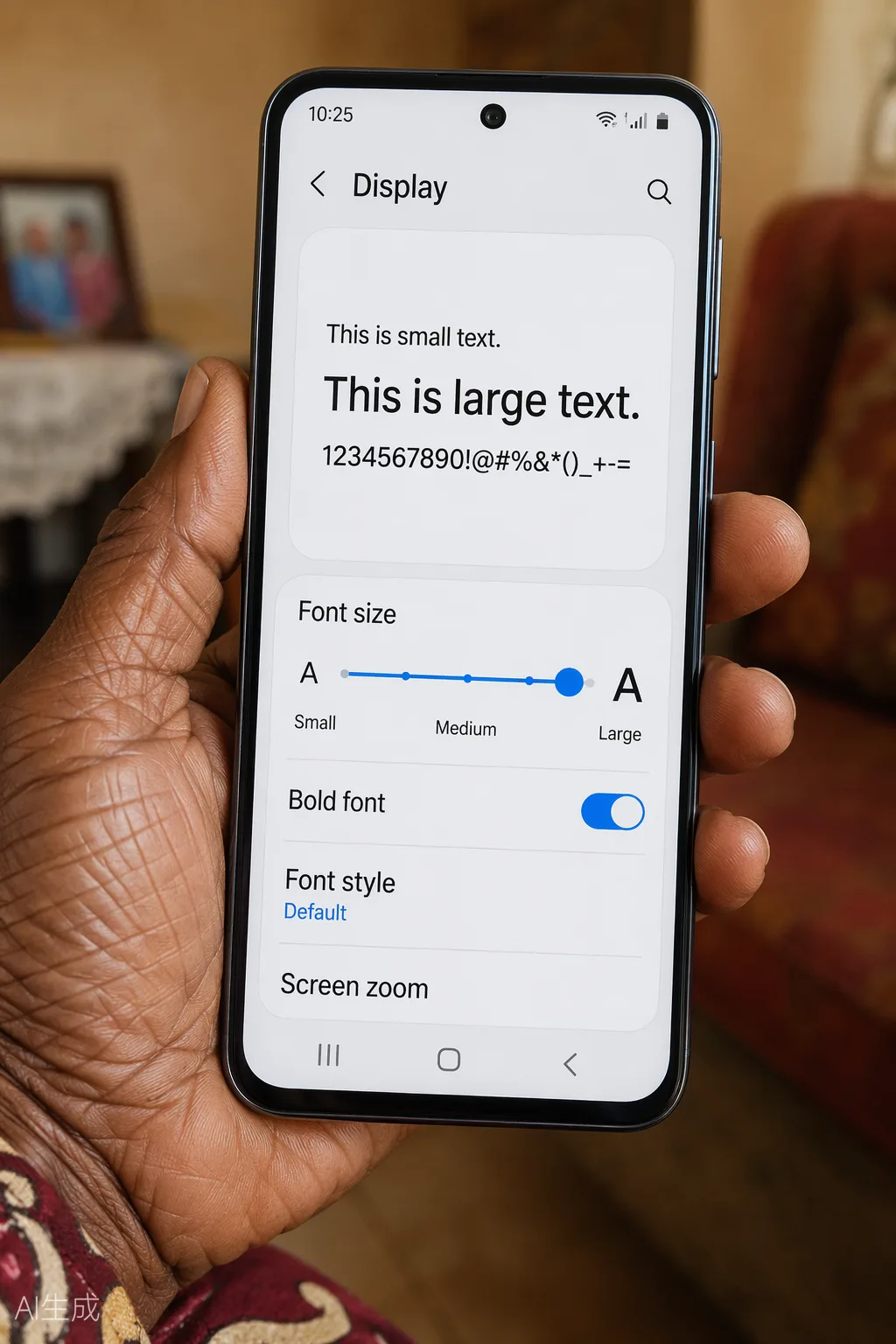
Android accessibility settings screen showing larger text controls
The Opportunity
"Voice-first, Swahili-native AI health tools could bridge the gap — but none have been built yet."
Symbolic image: AI-generated for illustrative purposes. Not attributed to any real individual or institution.

Strategic Milestones to 2028

Moving Kenya's score from a critical 2.8 to a baseline 5.0 requires targeted, measurable action across all six pillars. The following milestones define the minimum threshold for meaningful inclusion.

01
Digital Literacy
Partner with Ajira Digital to establish elder-specific cohorts and deploy voice-first Kiswahili learning modules across county adult literacy hubs.
Target: 50,000 digitally literate older adults by 2028
02
Internet Access
Introduce smartphone subsidies paired with zero-rated senior data bundles via Safaricom and Airtel, integrated into Inua Jamii distribution channels.
Target: 70% device ownership among persons aged 70+
03
Telemedicine Infrastructure
Formalise localised technical helpdesks, mandate county budgets for CHP device upgrades, and compensate data costs for eCHIS synchronisation.
Target: Functional telemedicine for 60% of rural older adults
04
Geriatric Healthcare
Introduce formal gerontology modules into the Kenya Medical Training College (KMTC) curriculum and establish dedicated elder care units in county referral hubs.
Target: At least 500 certified geriatric care professionals
05
AI Healthcare Alignment
Incentivise tech startups to build localised voice-first health diagnostics, Kiswahili-driven conversational agents, and automated medication management systems.
Target: 3 senior-specific AI health tools rolled out nationally
06
Accessibility Enforcement
Accelerate enforcement timelines for KEBS DKS 2952-1 standards and require all public health applications to pass senior accessibility audits before deployment.
Target: 100% compliance for public digital health portals by 2028
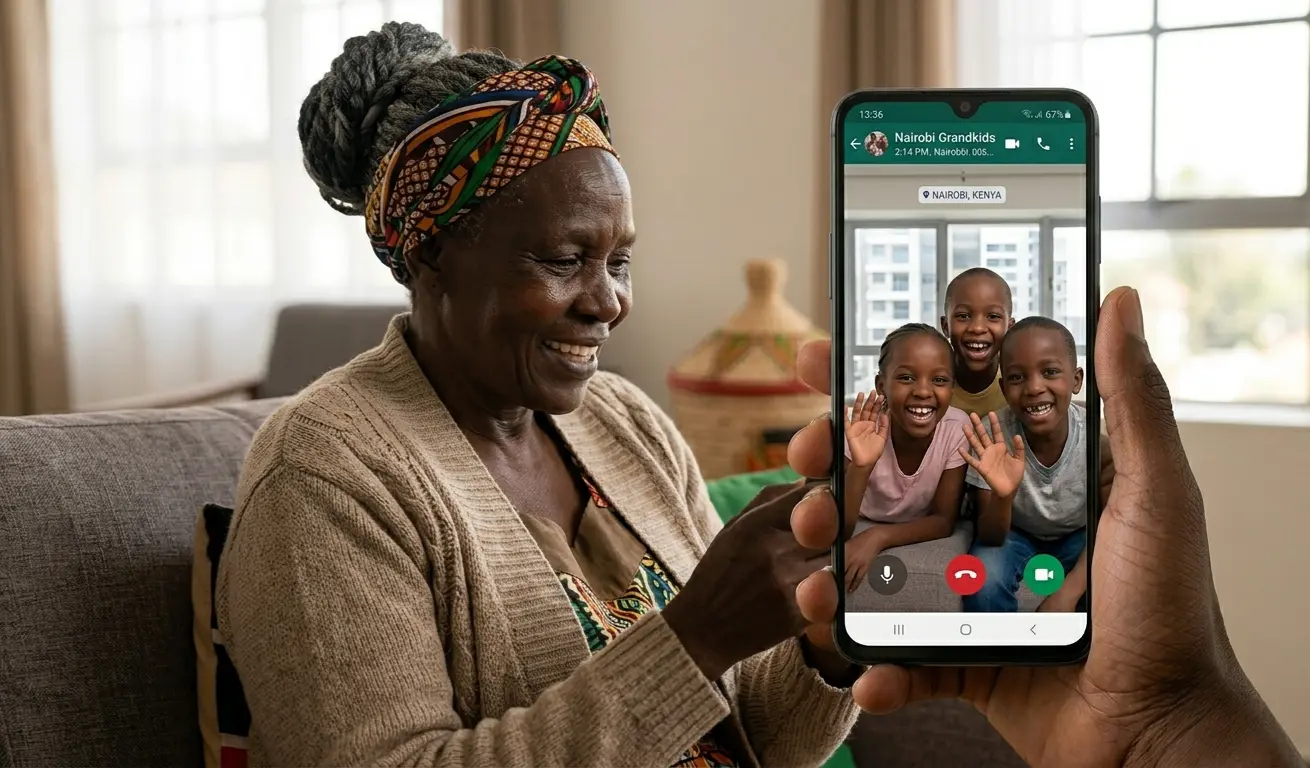
Older adult using WhatsApp on an Android smartphone
The Infrastructure Gap
"107,000 Community Health Promoters were given devices. The system went down for two consecutive months."
Symbolic image: AI-generated for illustrative purposes. Not attributed to any real institution.
KJO
Kevin Jonathan Otieno
Founder, Senior Citizens Tech Haven · Nakuru, Kenya
Kevin holds a Diploma in Television Programmes Production and a BA in Communications and Public Administration. He founded Senior Citizens Tech Haven (SCTH) — a digital literacy platform for older Kenyans — and rebuilt it in 2026 as a full Progressive Web App with AI companion Elsah. He is also the creator of SautiSahihi Civic Edition, a civic technology PWA for Kenyan seniors, and the founder of Elmac Communications Limited, an AI-powered digital presence agency for Kenyan SMEs.