Why This Matters More Than Most People Realise
For decades, conversations about Africa's future focused on youth. Young entrepreneurs. Young voters. A young workforce driving economic growth. Those discussions remain important. But another story is quietly unfolding — one that most governments, businesses, and families are not yet prepared for.
Millions of Africans are living longer than any previous generation. This is a sign of progress. Better healthcare, improved sanitation, advances in disease prevention, and improved maternal care have helped push life expectancy higher across much of the continent.
But longer lives create new responsibilities.
Countries must plan for healthcare systems capable of managing chronic illnesses, sustainable pension and social protection programmes, age-friendly housing and public transport, digital services that remain accessible to older adults, and support systems for families caring for aging relatives.
Unlike Europe, North America, and East Asia — which grew wealthy before their populations grew old — many African countries are confronting these challenges while still addressing broader development priorities. That makes preparation not just important, but urgent.
What Is Actually Happening?
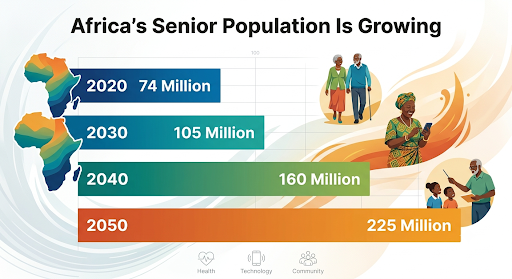
Africa's population structure is gradually but unmistakably changing. While younger generations still make up the majority, the number of older adults is growing faster than at any point in the continent's recorded history.
Upload this file to your /images/ folder on GitHub
— up from 74 million in 2020
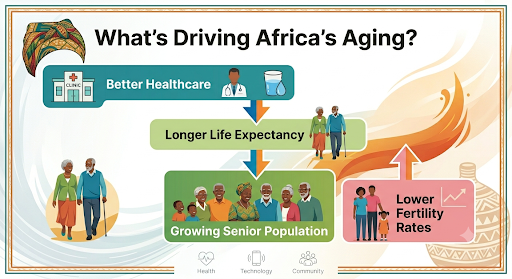
Several forces are driving this shift together:
- Life expectancy rising significantly across Sub-Saharan Africa
- Fertility rates declining as education levels and urbanisation increase
- Improved access to healthcare reducing early deaths
- Better nutrition and sanitation in many communities
- Changing family structures reducing household size
Taken together, these forces are gradually but permanently reshaping the continent's demographic profile.
What Is Driving Africa's Aging?
Two broad trends are at the centre of this shift — and both are signs of development, even though they create new challenges.
Upload this file to your /images/ folder on GitHub
People Are Living Longer
Life expectancy has improved significantly across many African countries over recent decades. According to World Bank data, advances in healthcare, disease prevention, sanitation, and maternal and child health care have all contributed to longer lives. Sub-Saharan Africa's average life expectancy rose from approximately 50 years in 1990 to above 63 years by the early 2020s — a remarkable improvement in a single generation.
Families Are Having Fewer Children
Fertility rates have declined meaningfully across much of the continent as education levels rise, urbanisation increases, and economic conditions evolve. According to demographic data, the average number of births per woman in sub-Saharan Africa has dropped substantially since the 1980s, though it remains higher than most other world regions. As this rate continues to decline, the proportion of older people in the overall population gradually increases.
Together, these two trends change population structures in ways that are slow to reverse — and that demand long-term planning now.
Who Is Affected?
The honest answer is: everyone. But the impacts differ depending on where you stand.
Upload this file to your /images/ folder on GitHub
Governments and Policymakers
Governments must plan and fund healthcare systems capable of handling growing numbers of people living with chronic conditions such as hypertension, diabetes, and arthritis. Pension and social protection programmes — many of which are under-resourced across Africa — must be strengthened or built from scratch. Public infrastructure must become more age-friendly: accessible transport, hospitals with geriatric wards, and digital services that older citizens can actually use.
Families
Across Africa, families remain the primary caregivers for most older adults. As urbanisation accelerates, adult children move to cities for work, and traditional extended family networks face new pressures. Families are finding that the care responsibilities they grew up expecting are harder to fulfil when they live hundreds of kilometres away from aging parents.
Older Adults Themselves
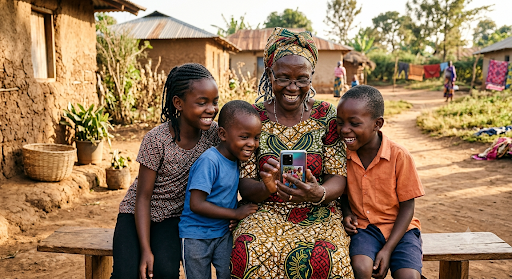
Older adults need access to healthcare, financial security, safe housing, transport, social connection, and increasingly, digital services. Those without digital skills risk being excluded from banking (mobile money), healthcare (telemedicine), government services (eCitizen), and even family communication (WhatsApp).
Young People
Today's young adults will become tomorrow's older generation. The systems and attitudes built today will directly shape their quality of life in 30 to 40 years. This makes aging everyone's business — not just a concern for the elderly.
Where Is This Happening Across Africa?
The pace of aging varies significantly across the continent, and understanding these differences matters for policymakers and communities alike.
North Africa — countries such as Tunisia, Morocco, Algeria, and Egypt — is further along in the demographic transition. Lower fertility rates and older population structures mean these nations are already dealing with the healthcare and pension pressures that the rest of Africa will face in the coming decades.
Sub-Saharan Africa, including Kenya, Ghana, Nigeria, Ethiopia, and Tanzania, remains relatively young — but the aging trend is clearly underway. Fertility rates are declining, life expectancy is rising, and urbanisation is changing family structures at an accelerating pace.
A Continent-Wide Trend
Africa is not a single story. The pace of aging varies enormously between countries and between urban and rural areas within countries. However, the overall direction is consistent across the continent — and that direction requires attention today, not in 2040.
Africa's Emerging Silver Economy
Older adults are too often discussed only in terms of needs and costs. That framing is not only incomplete — it is economically blind.
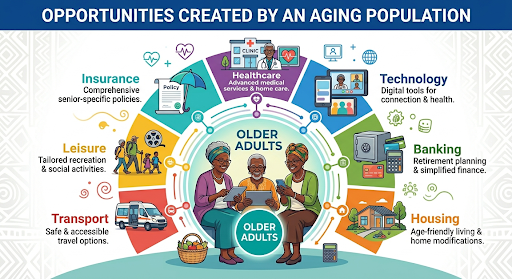
Older adults are consumers. They purchase healthcare services, financial products, housing solutions, communication tools, transport services, and leisure products. As Africa's older adult population grows from 74 million to 225 million, demand for products and services designed for this demographic will grow in parallel. This is what economists call the silver economy — and it represents one of Africa's most underserved and fastest-growing market opportunities.
Upload this file to your /images/ folder on GitHub
Businesses that understand older adults — their preferences, their challenges, their purchasing power, and their potential — will find one of Africa's most significant untapped markets. From financial technology built for retirement planning to telemedicine services designed for rural older adults, from accessible housing modifications to leisure programmes for active older adults, the opportunities are substantial.
Africa's older adults are not a burden waiting to be managed. They are consumers, community leaders, experienced workers, and knowledge holders. The silver economy is real — and the businesses that understand this first will have a significant advantage.
— Senior Citizens Tech Haven, 2026
Why This Matters for Technology
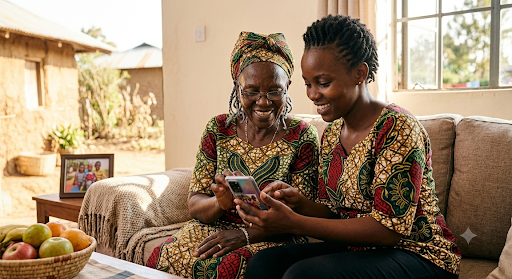
Population aging and digital transformation are advancing simultaneously across Africa. This convergence creates both an opportunity and a risk.
Upload this file to your /images/ folder on GitHub
Government services are moving online — from eCitizen for passports and driving licences to the Social Health Insurance Fund (SHIF) for healthcare claims. Banking has moved to mobile — M-Pesa alone handles billions of shillings in transactions daily, and those without basic smartphone skills risk being excluded from the financial system entirely. Healthcare is moving to telemedicine. Education is moving online. Family communication happens on WhatsApp.
For older adults with digital skills, this digital shift opens extraordinary possibilities:
- Accessing healthcare from home via telemedicine
- Managing finances and receiving pension payments through mobile money
- Communicating with children and grandchildren in other cities or countries
- Accessing government services without travelling long distances
- Staying informed and maintaining mental sharpness through digital engagement
For older adults without digital skills, the same shift means exclusion — from services, from family, from economic life.
This is why digital literacy is not a luxury for older adults. It is healthcare. It is financial inclusion. It is social connection. And it must be treated with the same seriousness.
The Digital Exclusion Risk
Without deliberate investment in digital literacy for older adults, Africa risks creating a two-tier society: one connected and empowered, one left behind. That divide will fall disproportionately on the oldest, the most rural, and the least educated — those who already face the greatest vulnerabilities.
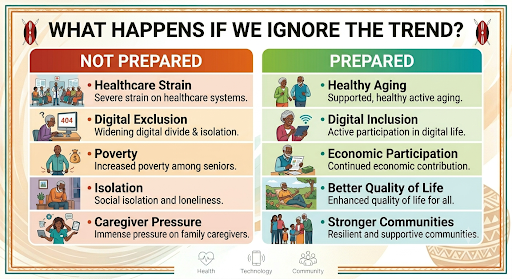
What Happens If We Ignore the Trend?
The consequences of inaction are concrete. Below is the stark difference between a society that prepares for its aging population and one that does not.
Upload this file to your /images/ folder on GitHub
The choice is not between aging and not aging. Africa's population is already growing older. The choice is between preparing — or being overwhelmed.
Kenya's Aging Future: A Preview of What Lies Ahead
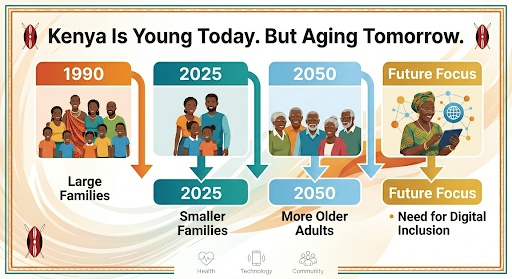
Kenya remains a relatively young nation. But the trajectory is unmistakable.
Upload this file to your /images/ folder on GitHub
The data tells a clear story: Kenya in 1990 was characterised by large families and high fertility. By 2025, family sizes are smaller, urbanisation is higher, and life expectancy has improved significantly. By 2050, Kenya will have substantially more older adults than it does today — and the systems to support them must be built now, not then.
Several developments are accelerating this shift in Kenya specifically:
- Life expectancy has risen to approximately 68 years, up from 54 years in 1990 (World Bank)
- Family sizes are shrinking — the average Kenyan woman now has approximately 3.4 children, down from over 8 in the 1970s
- Urbanisation continues to pull young people away from rural homes and aging parents
- Digitisation of government services through eCitizen, mobile banking through M-Pesa and Equity, and health records is accelerating — leaving those without digital skills behind
For older Kenyans, these changes create both opportunities and risks. Digital banking, telemedicine, AI tools, and online government services can improve quality of life — but only for those with the skills to use them.
Kenya Has an Opportunity
Kenya has an opportunity to become a leader in senior digital literacy and age-friendly technology across Africa. With a strong mobile money infrastructure, a growing tech sector, and an increasingly digitised government, the building blocks are already here. What is needed now is deliberate focus on older adults — not as an afterthought, but as a priority.
What Can We Do Now?
This is not a crisis to be feared. It is a transition to be managed — with intelligence, compassion, and urgency. Here is what different actors can do.
Governments
- Expand social protection programmes
- Strengthen healthcare for chronic disease
- Invest in age-friendly public services
- Fund senior digital literacy initiatives
- Develop a national aging policy
Families
- Support older relatives in learning technology
- Reduce social isolation through regular contact
- Promote intergenerational learning at home
- Teach M-Pesa, WhatsApp, and eCitizen
Businesses
- Design products accessible to older users
- Build digital services with larger text and simple interfaces
- Recognise the growing silver economy
- Create services in local languages including Kiswahili
Older Adults
- Remain curious — it is never too late
- Learn digital skills one step at a time
- Seek support from family, community, and platforms like SCTH
- Stay engaged in community and civic life
💬 Need Help Getting Started with Technology?
Ask Elsah — our AI companion built specifically for older Kenyans. Simple language. No jargon. No rush. No judgment. Available 24/7.
✨ Chat with Elsah Now →Sources and References
This article draws on publicly available data from internationally recognised institutions. Readers are encouraged to consult the latest publications directly:
- United Nations DESA, Population Division — World Population Prospects (annual updates)
- World Health Organization (WHO) — Global Health Observatory, Ageing and Health factsheets
- World Bank — World Development Indicators, Life Expectancy and Fertility Rate data
- International Labour Organization (ILO) — Social Protection Statistics, Pension Coverage in Africa
- African Union Commission — Policy Framework and Plan of Action on Ageing
Data Note: Demographic projections are estimates based on current trends and are periodically revised as new data becomes available. Figures cited represent the most widely used UN medium-variant projections at the time of publication (June 2026).
Frequently Asked Questions
Yes. According to United Nations population projections, the number of Africans aged 60 and above is set to grow from 74 million in 2020 to approximately 225 million by 2050. Africa remains the world's youngest continent, but this demographic shift is already underway — driven by longer life expectancy, declining fertility rates, urbanisation, and improved healthcare access.
North African countries such as Tunisia, Morocco, Algeria, and Egypt have older population structures due to lower fertility rates and longer life expectancy. In Sub-Saharan Africa, Kenya, Ghana, Nigeria, and Tanzania remain relatively young but are experiencing the same aging trajectory. The pace varies, but the direction is consistent across the continent.
Key challenges include inadequate healthcare infrastructure for chronic diseases, weak pension and social protection systems, erosion of traditional family support due to urbanisation, a lack of institutional elder care facilities, and the growing risk of digital exclusion as essential services move online. Many African countries are attempting to strengthen these systems while demographic change is already underway.
Technology can help through telemedicine for remote healthcare access, mobile health apps for chronic disease monitoring, AI-assisted diagnostics to address doctor shortages, and digital literacy programmes that include older adults. In Kenya specifically, M-Pesa, eCitizen, and WhatsApp are already transforming daily life — but only for those with the skills to use them. The key is designing tools with older users in mind: larger text, simple interfaces, voice commands, and support in Kiswahili and other local languages.
The silver economy refers to the growing market of products and services designed for older adults — covering healthcare, financial services, housing, technology, transport, and leisure. As Africa's older adult population grows from 74 million to 225 million, this represents one of the continent's most underserved and fastest-growing economic opportunities. Businesses that understand and serve older consumers early will have a significant competitive advantage.
Absolutely not. At Senior Citizens Tech Haven, we work with older Kenyans every day who are learning smartphones, WhatsApp, M-Pesa, and email for the very first time — at 60, 70, and even 80 years old. The key is patience, plain language, and starting with one small step. Technology is for everyone. Including you.
Kenya remains a relatively young nation, but demographic indicators show it is following the same trajectory as the rest of the continent. Longer life expectancy, smaller family sizes, rapid urbanisation, and the digitisation of government services through eCitizen and banking through M-Pesa are all accelerating the need for digital inclusion among older Kenyans. Kenya has the infrastructure to lead on this — but must act with deliberate urgency.
📅 Published: June 23, 2026 · Last reviewed: June 26, 2026 · Next review: September 2026
Sources: UN DESA · World Bank · WHO · ILO
Spot an error? Contact us →